

A Gothic Halloween Tale

A Halloween gift for my readers
This Halloween, I wanted to share something special with you: an original Gothic tale set in the shadowed streets of old Paris.
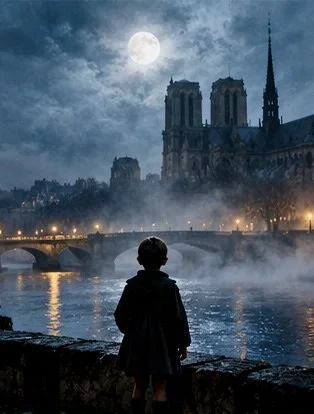
Our story begins on October 31, 1800, in a city still haunted by the Revolution. Its great bells have fallen silent, its churches bear the scars of history, and the fog along the Seine conceals more than the darkness of night.
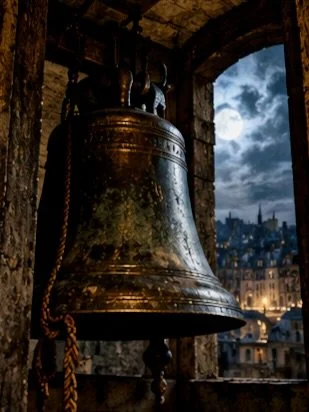
But shortly before midnight, a bell begins to ring from a tower that should no longer exist.
Light a candle, settle in, and let the streets of old Paris lead you into the shadows.
And remember…
In Paris, the bells do not always ring for the living.
Happy Halloween,
Philip James
The Bell That Rang at Midnight
A Gothic Halloween Tale
By Philip James
Paris, October 31, 1800
For generations, the bells of Paris had governed the lives of its people. They announced the dawn, summoned the faithful to prayer, marked the passing of the hours, and tolled for those whose earthly journeys had come to an end. Their voices rose above the rooftops in great waves of bronze, crossing the Seine and reaching even the poorest quarters of the city. A Parisian might close his eyes and know, by the sound alone, which church was calling and what occasion had brought its bells to life.
Then came the Revolution, and the city learned the meaning of silence.
Churches were stripped of their treasures, their doors were closed or their purposes changed, and bells that had rung for centuries were hauled from their towers, broken apart, and melted down. Some of their bronze would be turned into cannon; other fragments would enter the machinery of a new republic that had little patience for the old faith. At Notre-Dame, the destruction of the early 1790s had robbed the cathedral of most of its bells. The great Emmanuel had survived, but it would not return to its tower until 1802. The familiar chorus that had once filled the city was gone.
By the autumn of 1800, Paris remained a city between worlds. The worst violence of the Terror had receded, yet the restoration of religious life was incomplete. Napoleon Bonaparte, newly established as First Consul, would negotiate a Concordat with the papacy the following year. Priests were beginning to return, old wounds were slowly closing, and the people were learning how to live without expecting the knock of a revolutionary tribunal at every door. Yet the city had not recovered its former voice.
For now, the silence remained.
It was into this uneasy quiet that the first bell rang.
The sound came shortly before midnight, when fog had gathered along the Seine and the opposite bank had disappeared entirely. It was a single, low note, so deep that the windowpanes trembled in their frames. The sound travelled over the rooftops, passed through the narrow streets, and faded into the mist.
In a cramped garret beneath the roof of a house near the river, a boy opened his eyes.
For much of the previous winter, he had lived among the forgotten corners of Paris, sleeping beneath market stalls, sheltering in doorways, and learning which streets to avoid after dark. Hunger had become an old companion, and he had grown accustomed to the indifference of strangers. Most people passed him without a glance, as though a child could become part of the pavement if he remained there long enough.
Madame Vautrin had been different.
She had found him one bitter morning near the steps of a church, thin as a stray cat and shivering beneath a coat that was little more than a collection of rags. He had been trying to sleep with his knees drawn to his chest, his bare fingers tucked beneath his arms. When she approached, he had opened his eyes but had not moved. He had learned that sudden movements sometimes brought a kick, and that questions from strangers were rarely asked out of kindness.
Madame Vautrin had asked his name, whether he had eaten, and where his family might be found. He had answered the first question and could not answer the others.
She had taken him home.
She was not a woman given to tenderness, and she had made that clear from the beginning. There were rules in her house, chores to be done, and no tolerance for lies or foolishness. Yet she had given him a small room beneath the roof, a blanket thick enough to keep out the winter cold, and a place at her table. She never called him her son, and he had never asked her to. But for the first time in years, he had a door he could close at night and someone who would notice if he failed to come home.
He had begun, cautiously, to believe that he might belong somewhere.
Tonight, however, the bell had pulled him from sleep.
He sat upright and listened. For weeks, he had been haunted by a dream of black water and pale hands reaching from beneath its surface. The dream always ended with a voice calling from somewhere under the river, followed by the distant tolling of a bell. He had grown accustomed to waking with his heart racing, but this time the sound had been so real that he could still feel its vibration in his chest.
He swung his feet to the cold floor and reached for the candle beside his bed. The flame trembled as he lit it, revealing the familiar shapes of his little room: the narrow bed, the patched blanket, the chair with one uneven leg, and the small wooden cross that Madame Vautrin had placed on the windowsill the day he arrived.
He had not prayed in months. Not since the night his mother disappeared.
A second bell rang.
This time, the sound seemed to come from the narrow streets behind the house, from somewhere north of the river. It was not the bright note of a small chapel bell, nor the deep, commanding voice of a cathedral. It sounded older than either, as though its bronze had been buried for centuries and had only now remembered how to speak.
The boy pulled on his coat and descended the stairs.
At the foot of the staircase, the house was dark. The fire in the kitchen had burned to embers, and the smell of yesterday's bread lingered in the air. He had nearly reached the front door when he heard a floorboard creak above him.
“Where are you going?”
Madame Vautrin stood at the top of the stairs in her nightdress, a dark wool shawl drawn around her shoulders. She was a narrow woman with silver hair, sharp eyes, and a face that seemed to have been carved from something harder than flesh. Years of hardship had taught her to keep her thoughts to herself. In Paris, that had often been the difference between surviving and disappearing.
“I heard a bell,” he said.
Her expression changed.
It was a small change, no more than a tightening around the mouth, but he saw it. She glanced toward the door, then toward the darkened windows overlooking the street. For an instant, the hard composure she wore like armor fell away, and the woman beneath it looked terribly old.
“No,” she whispered.
“I heard it.”
“You heard nothing.”
“It rang twice.”
She descended the stairs and took his wrist. Her fingers were cold, and her grip was unexpectedly strong.
“Listen to me. Go upstairs. Lock your door. If you hear it again, do not answer.”
“Answer what?”
She released him as though he had burned her.
“Go to bed.”
But he was already looking through the narrow window beside the door. A pale light glimmered at the end of the street, where a passage ran between two leaning buildings. He had passed it a hundred times. Its entrance was usually cluttered with rubbish or blocked by a cart abandoned against the wall. Tonight, it stood open.
A third bell rang.
Madame Vautrin made a small, broken sound and crossed herself.
“Do you know what happened here?” she asked.
He shook his head.
“Before the Revolution, there was a chapel in that passage. A small one, hardly more than a room with a stone altar. The people who lived nearby went there to pray when the larger churches were closed. There was a bell above its roof, and it rang at midnight for the dead.”
“Every night?”
“Every night, until the Revolution.”
She looked toward the passage, and her voice fell to a whisper.
“They took the bell away. I saw them do it. Men came with ropes and crowbars. They lowered it from the tower, dragged it through the streets, and carried it away to be melted down. The chapel was sealed. The altar was broken. The priest disappeared, and so did the children who used to gather there.”
“What children?”
Madame Vautrin was silent for so long that he thought she would not answer.
“My younger sister was one of them.”
He stared at her. She had never spoken of a sister. He knew little about Madame Vautrin's life before she took him in, only that she had lived in the same house for many years and that sometimes, when she believed herself alone, she sat beside the kitchen window with an old ribbon in her hands.
“She went to that chapel?” he asked.
“She went there on the last night I saw her alive.”
The bell rang again, and Madame Vautrin tightened her grip on his wrist.
“I have spent seven years trying not to remember that sound,” she whispered. “Do not make me hear it again.”
He looked at the passage. The pale light at its far end brightened, and the air carried the scent of wet earth and extinguished candles.
Then he heard a voice.
It was faint, almost lost beneath the wind, but he knew it as surely as he knew the sound of his own name.
“Come home.”
His breath caught.
It was his mother.
He pulled away from Madame Vautrin.
“Wait!” she cried.
But he had already opened the door and run into the street.
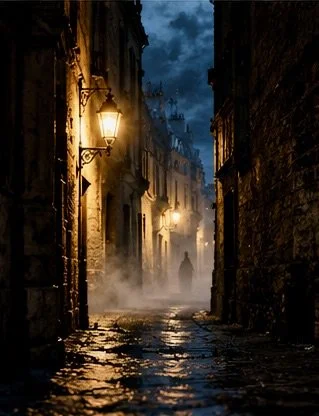
The passage narrowed as he entered it, the walls pressing close on either side. His shoes slipped on the wet stones. Behind him, Madame Vautrin called his name, but her voice grew distant with each step, as though the street were lengthening between them. The pale light ahead flickered. It was not the warm gold of a lantern, but a cold, silvery glow that seemed to rise from the ground.
At the end of the passage stood a door.
It was made of blackened oak, swollen by damp and marked with a cross so deeply carved that the grooves had filled with grime. A chain hung across it, though the links lay broken on the ground. The iron keyhole was dark with age.
The boy had never seen this door before, yet he knew it.
In his dreams, he had stood before it while black water climbed the walls. He had heard a woman singing on the other side, a lullaby whose words he could never quite remember. He had awakened each time before he could turn the handle.
Tonight, a small iron key lay on the ground before the threshold.
He picked it up. It was warm.
The lock turned without resistance.
The door opened inward.
Beyond it lay the chapel.
The roof had partly collapsed, exposing a narrow strip of night sky. Dead leaves covered the floor. The altar stood broken at the far end, and the plaster walls were stained black by years of damp. There were no candles, yet the room glowed with a faint light that seemed to come from the stones themselves.
Above the altar, where a crucifix had once hung, there was an empty niche.
The boy stepped inside.
The air was cold, but he could hear breathing. It came from the shadows behind the altar, slow and uneven, like someone trying not to cry.
“Mother?”
The sound stopped.
For a long moment, nothing moved. Then a figure emerged from the darkness.
She wore a plain grey dress, the kind women wore when they had little money and fewer choices. Her hair fell loosely around her face. Her hands were pale, and her cheeks were hollow, but the boy knew her at once.
He had not seen her in three years.
She looked exactly as she had on the last morning he remembered: tired, frightened, and trying to smile for his sake.
He ran toward her.
She lifted one hand.
“Do not come closer.”
He stopped so abruptly that his shoes scraped against the stones.
“Mother?”
Her eyes filled with tears.
“Oh, my poor child.”
He had imagined this moment a thousand times. In some dreams, she returned to their old room and sat beside his bed. In others, he found her waiting near the river, where she would take his hand and lead him home. He had imagined her older, perhaps, with grey hair and lines around her eyes. He had imagined her angry with him for failing to find her.
He had never imagined her looking at him as though she could not bear the sight of him.
“Where have you been?” he asked. “I looked for you. I waited. I thought you might come back.”
His mother closed her eyes.
“I wanted to.”
“Then come home.”
“I cannot.”
“Why?”
She glanced toward the empty niche above the altar. A tremor passed through the room, and dust sifted from the damaged ceiling.
“Because this place is not what you think it is.”
The bell sounded overhead.
The boy flinched. His mother did not. She had heard it before, perhaps many times, and the sound seemed to hurt her in a way that went beyond hearing.
“This chapel was built for the forgotten,” she said. “For those who died without family, without burial, without anyone to speak their names. When the city abandoned its churches, the dead were left here. When the bell was taken, the way between this world and the next was broken.”
“Then who is ringing it?”
His mother looked toward the roof.
“Someone who has been waiting a very long time.”
The boy followed her gaze. Above the altar, a narrow stairway rose into darkness. He had not noticed it when he entered. The steps were old stone, worn smooth in the middle by generations of feet. At the top, a square opening led into the tower.
“I can bring you home,” he said.
His mother shook her head.
“You cannot bring back what has already crossed over.”
“But you're here.”
“A part of me is.”
She reached toward him, then stopped before touching his face. Her fingers trembled in the air between them.
“I came here on the night they took the bell. I thought I could hide. I thought the chapel would protect me. But there were others here, and they were frightened. They had nowhere else to go. I stayed with them.”
The boy could barely breathe.
“You died here?”
His mother’s silence was answer enough.
He wanted to scream. He wanted to strike the altar with his fists and demand that the world explain itself. Instead, he stood perfectly still, because the woman before him was his mother, and he had already lost her once. He could not bear to frighten her away again.
“Why did you call me?” he whispered.
“I did not.”
The answer was so quiet he almost missed it.
“I never called you.”
The bell rang again, louder than before. The sound shook the chapel, and a thin crack appeared in the stone above the altar. From somewhere within the walls came a whispering, a multitude of voices speaking all at once. The boy heard names, hundreds of them, some spoken clearly, others reduced to breath and fragments of syllables. He heard the names of children, of old men, of women whose voices trembled with the last exhaustion of the dying.
And beneath them all, a single voice repeated his name.
His mother seized his hand.
“Listen to me. Whatever you hear, do not answer. The bell does not call the living. It calls those who have been forgotten, and sometimes it mistakes the living for the dead.”
“Then how did it know about me?”
“Because you have been listening.”
A shadow moved above the altar.
It was tall and narrow, with shoulders that seemed too broad for the space it occupied. The light around it dimmed. The whispers stopped one by one, until only the boy’s name remained, spoken from the tower in a voice that sounded almost like his own.
His mother pulled him toward the door.
“Go.”
“I won't leave you.”
“You must.”
“I've waited three years!”
“And I have watched you every day.”
Her voice broke. For the first time, she looked like the mother he remembered: not a ghost, not a stranger, but the woman who had once held him through thunderstorms and sung to him when hunger kept him awake.
“I have watched you grow,” she whispered. “I have watched you learn to be brave when you were frightened, and kind when the world gave you no reason to be kind. I have wanted to touch your hair, to kiss your forehead, to tell you that none of this was your fault. But the dead cannot always give comfort to the living. Sometimes we can only ask them to go on without us.”
The shadow descended one step from the tower.
The stone beneath the boy’s feet trembled.
His mother pressed something into his palm. It was a small silver medal, blackened at the edges, with a worn image of a saint upon it.
“Keep this,” she said. “And remember that you were loved.”
The boy closed his fingers around the medal.
For a moment, the chapel seemed to disappear. He was standing in their old kitchen, sunlight lying across the table, his mother humming as she kneaded bread. He could smell warm flour and rosemary. He could hear the ordinary sounds of a city that had not yet learned to fear its own silence. He was small again, and she was alive, and there was nothing in the world that could take her from him.
Then the vision broke.
The bell began to ring continuously.
His mother pushed him toward the door with a strength he would never have believed possible. The air filled with dust. The empty niche above the altar glowed white, and the voices of the forgotten rose into a terrible chorus.
He stumbled into the passage.
Behind him, his mother spoke one final time.
“Do not let them forget us.”
The door slammed shut.
The sound of the bell stopped.
For several seconds, the boy could hear nothing at all. He stood in the narrow passage, shaking, with the silver medal pressed so tightly into his palm that its edges cut his skin. The pale light had vanished. The chapel door was gone, replaced by a wall of old stone, its surface damp and unbroken. There was no keyhole, no chain, no carved cross.
Only a patch of darkness where the doorway had been.
He ran.
By the time he reached the street, the eastern sky had begun to lighten. He stumbled through the front door of Madame Vautrin’s house and found her waiting in the hallway. She had not gone upstairs. Her shawl lay on the floor, and her face was wet with tears.
When she saw him, she crossed the room and gathered him into her arms.
For a moment, he stood rigid with surprise. He could not remember the last time anyone had held him without wanting something in return. Then his arms went around her, and he buried his face against her shoulder.
She held him as though the city might try to take him away.
“I thought I had lost you,” she whispered.
“I came back.”
She drew away and touched his face, examining him for injuries. Then she noticed the medal in his hand.
“What is that?”
He opened his fingers.
Madame Vautrin stared at the silver medal as though she had seen a dead person walk into the room. She took it with trembling fingers and turned it over. On the reverse, beneath a thin layer of soot, were two tiny engraved letters beside the date.
1793.
She sank into the chair beside the wall.
“That is impossible,” she whispered.
“Why?”
She held the medal against the light.
“Because I buried your mother.”
The boy felt the floor tilt beneath him.
Madame Vautrin looked up at him, and all the years of silence between them seemed to gather in her eyes.
“I buried her in a common grave outside the old cemetery. I was there when they carried her away. I saw the earth placed over her. I know what I saw.”
“Then who was in the chapel?”
Madame Vautrin could not answer.
From somewhere far across Paris came the faintest sound: a single, low note, so distant that it might have been the wind moving through a broken window or a cart rolling over stones. The boy and the old woman turned toward the door.
Neither spoke.
The sound faded, leaving the city as quiet as before.
In the days that followed, the boy searched the old quarter for the chapel. He returned to the passage in daylight and found only a narrow space between two buildings, blocked by fallen stones and a tangle of weeds. He asked shopkeepers, street sweepers, and an old priest who had returned to the city after years of hiding. None remembered a chapel there. A few had heard stories of a small church that once stood nearby, but no one could agree on its name, and no record remained of its bell.
Madame Vautrin refused to discuss the night again.
She did, however, allow the boy to keep the medal. She placed it in a small wooden box and told him never to wear it outside the house. Sometimes, when she thought he was asleep, he heard her whispering a prayer in the darkness. Once, he heard her speak the name of her sister. Another night, she spoke his mother's name.
Winter came. The Seine rose and fell beneath its bridges. The city changed slowly, with new faces appearing in old doorways and old names fading from the signs above the shops. Men spoke of Bonaparte and the future. Priests returned to churches where the doors had been locked for years. Somewhere, a bell rang for a wedding, and somewhere else a bell tolled for a funeral. Paris was learning, cautiously, to find its voice again.
But the boy never heard that particular bell in daylight.
He heard it only when the fog came down upon the river, when the streets emptied and the lamps burned low. Always, it sounded from somewhere that could not be found. Sometimes it rang once. Sometimes three times. Once, in the middle of January, it rang seven times in succession, and the boy woke from a dream of pale hands reaching through black water.
He never went looking for it again.
Years later, when the great Emmanuel was returned to Notre-Dame's tower, the city gathered to hear its voice. People stood along the streets and on the bridges, their faces lifted toward the cathedral. The sound rolled across the Seine and over the rooftops, deep and magnificent, reminding the people of Paris that some things could survive even the longest silence.
The boy, older now, stood among the crowd with the silver medal hidden beneath his coat.
He listened to the great bell ring, and for a moment he felt peace.
Then, beneath Emmanuel's mighty voice, he heard another note.
It was softer, lower, and terribly far away.
It came from the old quarter, from a place where no tower stood and no chapel remained. It lingered beneath the sound of the cathedral bell like a second heartbeat, waiting for the city to fall silent once more.
The boy closed his eyes.
He remembered his mother's final words.
Do not let them forget us.
And he understood, at last, what the bell had wanted.
It had not called him to the dead because it wished to take him from the living. It had called him because the dead had been left without names, without prayers, without anyone to remember that they had ever walked the streets of Paris. The bell was not asking for another soul. It was asking for witness.
So he began to write down the names he could remember. His mother's name. Madame Vautrin's sister's name. The names of those who had disappeared in the Revolution, of children whose families had been scattered, of neighbors whose homes stood empty after the Terror. He wrote until his hand cramped and his candle burned low. He wrote because memory was the only bell the living could still ring for the dead.
Madame Vautrin sometimes sat beside him as he wrote. She never asked him to describe the chapel again, and he never offered. But one evening, when the fog drifted across the river and the first distant bell sounded, she placed her hand over his.
“You have a home here,” she told him.
He looked at her, surprised by the words.
“I know.”
“No,” she said softly. “I don't think you did. Not until tonight.”
He covered her hand with his own.
For a long while, they listened to the city breathing beyond the windows.
And somewhere beneath the stones of Paris, the hidden bell answered.
Not loudly. Not for long.
Just once, in the darkness.
A single note, deep beneath the streets of Paris.
A sound that should not have existed.
A sound that would never be forgotten.
For in Paris, even when the towers fall silent, something is always listening.
And not every bell rings for the living.
Thank you for joining me on this little journey into the shadows of old Paris.
May your Halloween be filled with beautiful mysteries, candlelit evenings, and stories that linger long after the final page.
Until the next tale,
Philip James 🕯️
